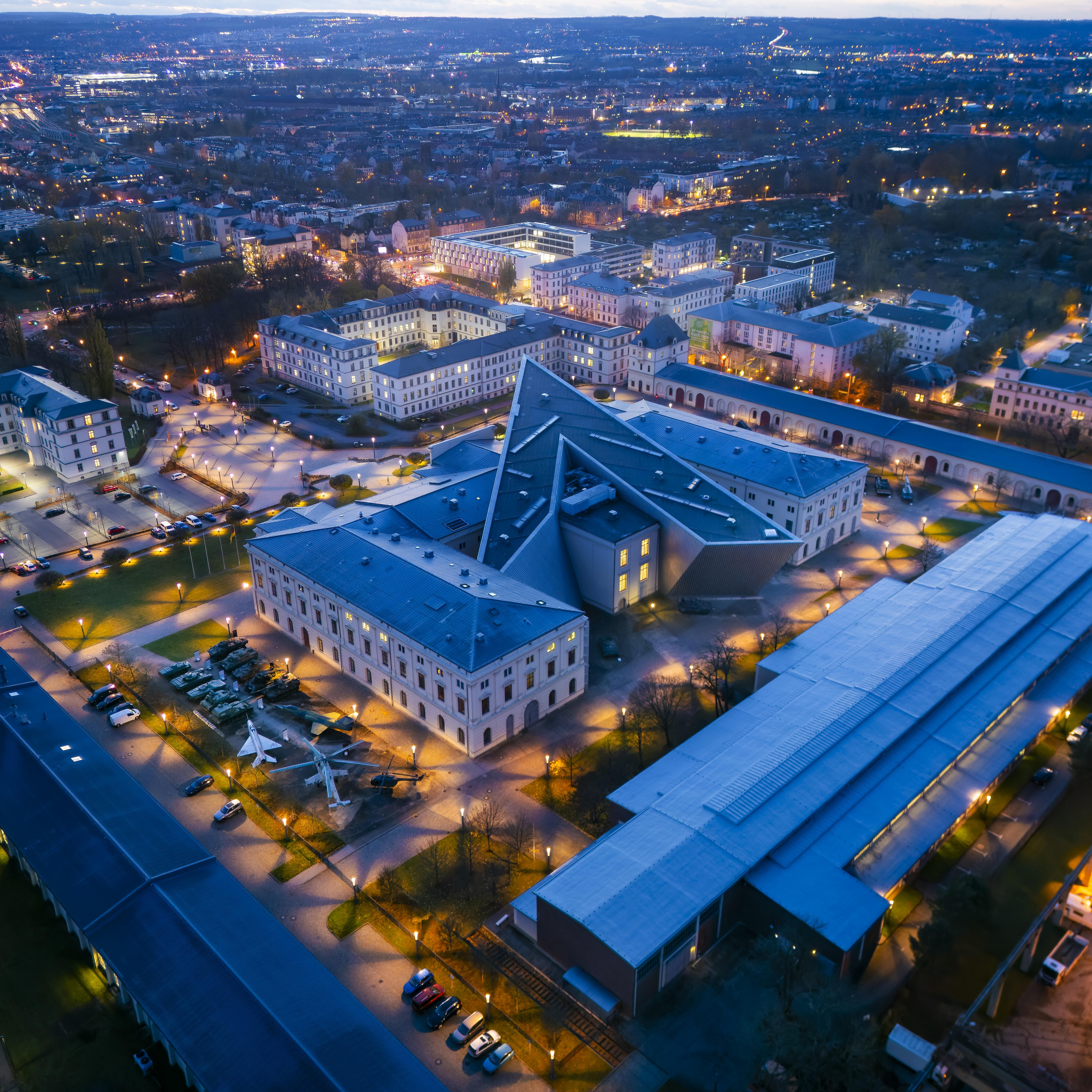
The Military History Museum illuminated at night.
Open copyright info

Architecture

A striking fusion of modern and historical architecture

A new structure that challenges continuity

Like a wedge, the new structure cuts through the historical arsenal building, symbolizing the profound rupture in German history after the Second World War. With its sharply angled walls, the new extension challenges established ways of seeing, breaks with spatial conventions and creates new perspectives. In doing so, the architect has implemented a guiding principle of the Military History Museum, in which traditional and inherited interpretations of a history marked by violence are identified, questioned and, where necessary, disrupted. The themed tour housed in the new extension addresses this challenge through modern, multi-perspective approaches to war and violence.

Libeskind’s wedge recalls the bombing of Dresden

[In developing his design, architect Daniel Libeskind engaged deeply with Dresden’s history. The visual axis of the wedge is precisely aligned with the point at which the first British aircraft dropped their light markers in February 1945, guiding the bomber formations. With its angle of 40.1 degrees, the wedge traces the funnel of destruction that reduced Dresden’s historic centre to rubble.

Despite the striking addition, the 19th-century arsenal building has been preserved. Just as the wedge represents modern perspectives on military history, the old building represents a more traditional mode of historical narration. It houses the chronological exhibition, which takes a traditional approach to military history, primarily through a linear chronological framework.