
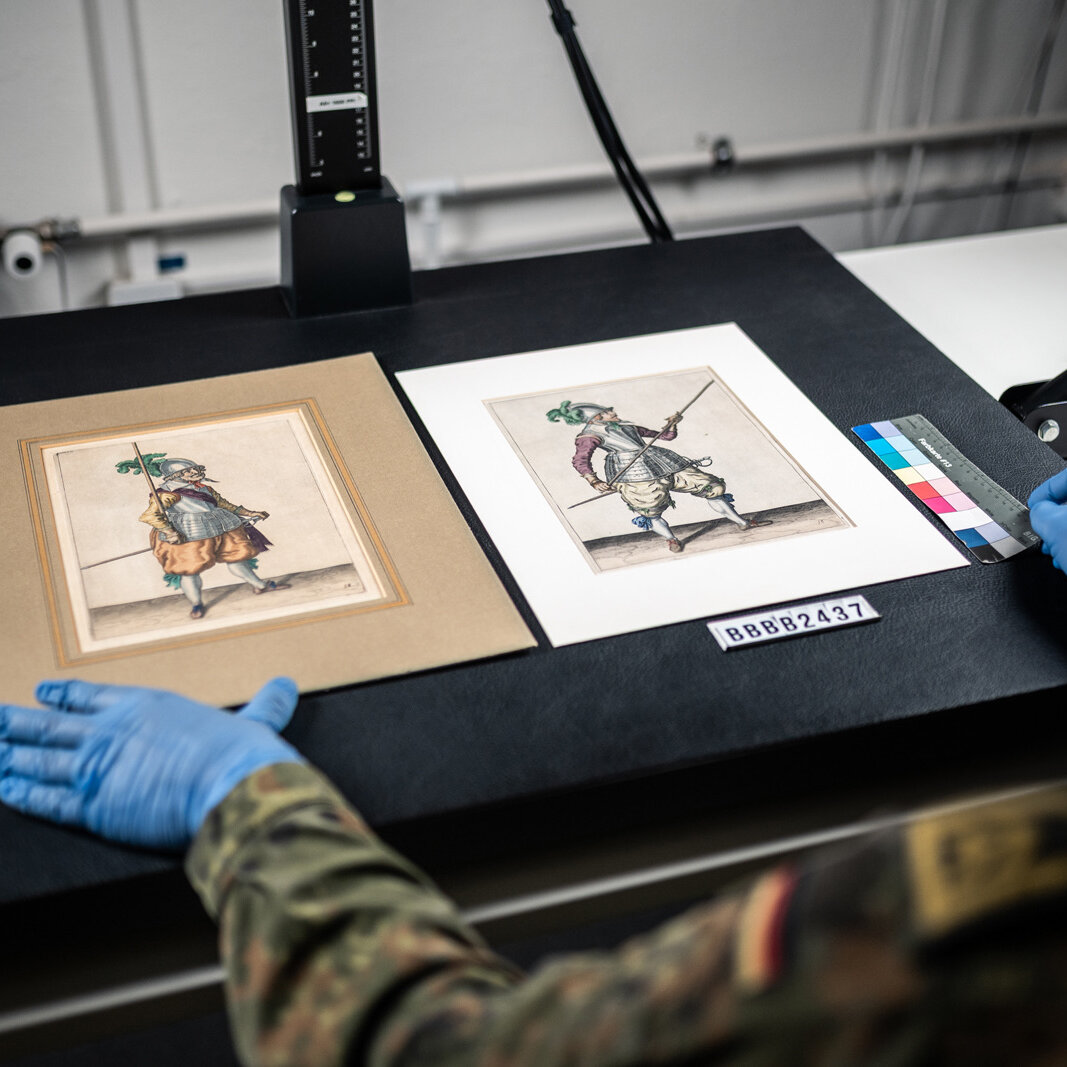
Please note: To ensure a smooth loan procedure, loan requests to the Military History Museum (MHM) must be submitted in writing to the Director at least six months before the start of the exhibition.
General terms and conditions of borrowing
Transport and packaging
The borrower shall bear all costs for the packaging and transport of the loan objects to and from the venue, including any necessary conservation support.
Packaging and transport must generally be carried out by a specialist fine art shipping company that meets the following requirements:
• Proven long-standing experience in packing, transporting, installing and dismantling museum objects in exhibitions both in Germany and abroad;
• Packing, loading and unloading of objects by trained art handlers with at least three years’ professional experience;
• Experience in handling the specific material groups involved (see appendix ‘General requirements’);
• Handling customs formalities, providing security escorts, and organizing or carrying out courier services, including travel arrangements in accordance with international standards;
• Provision of appropriate specialist packing materials (see appendix ‘General requirements’);
• Delivery and opening of climate-controlled crates 24 hours prior to transport;
• Provision of a mobile packing table where required;
• Direct transport is preferred;
• Temporary storage only by prior arrangement in secure, climate-controlled premises.
Transport vehicle
• Insulated, air-suspended and climate controlled;
• The packages must be capable of being securely fastened parallel to the direction of travel;
• A mechanical tail lift must be available for packages weighing more than 20 kg.
Transport must be organized as direct transport. Consolidated shipments are only permitted by prior agreement. Special transport conditions for particularly vulnerable or sensitive items will be communicated separately and at the earliest possible stage. The fine art shipping company shall provide the packaging.
Insurance
The borrower undertakes to insure the loan objects at the insurance values specified by the lender and shall bear all insurance costs. The lender shall receive a copy of the insurance certificate. The loan objects shall only be released to the borrower once a copy of the insurance certificate has been submitted to the lender.
Insurance shall be taken out on a ‘nail-to-nail’ basis and shall remain in force until the loan objects have been returned to the lender. Should the insurance period be exceeded due to late return, the borrower shall bear any additional costs incurred as a result. Any extension of the insurance period required in such circumstances must be arranged by the borrower without delay.
Where the liability risk is fully covered, in both amount and scope, by a federal indemnity, a guarantee under a self-insurance scheme, or a foreign state indemnity (e.g. US indemnity or equivalent), and the borrower provides appropriate evidence, the requirement to take out insurance may be waived.
Inventory labels
The lender’s inventory labels should normally remain on the object. However, alternative arrangements may be agreed.
Condition reporting
When the loan object is collected, the person collecting it will be provided with the condition report, which must be checked at each handover and signed by both the borrower and the lender to confirm its accuracy and completeness during both outward and return transport. Any changes must be reported immediately. The signed condition report must be returned together with the loan object.
Courier escort
If a courier escort is requested by us, the costs must be borne by the hirer.
Access
Staff of the MHM must be granted access to the object, as required and by prior arrangement, in the exhibition spaces, storage areas or temporary storage areas.
Exhibition installation
Once the loan objects have arrived, no further building work – particularly painting – may take place in the exhibition spaces. All paint must be completely dry throughout the exhibition area. During installation, no work or installation may take place above the objects.
Display cases should be fitted with laminated safety glass (8 mm thick) and a cylinder lock. For loan objects with an insured value exceeding €200,000, the cylinder lock must comply with resistance class 3 (P2BZ, 6-pin tumbler). Any requirement for an alarm system will be agreed contractually on a case-by-case basis.
Within the display case, any sources of emissions – such as adhesives, fresh wood, fibreboard, or coatings on plinths or mounts that have not yet fully cured – must be avoided. pH-neutral textile coverings or acid-free paper or board, as well as marble, Plexiglas or glass supports, are required. Where specific installation requirements must be observed, these are set out in the condition report and in the contract. Movement of the objects after installation should be avoided. In individual cases, however, the lender may stipulate different requirements.
Climate and light
A constant climate must be maintained during the transport, storage and display of the loan objects. Specific climate and lighting requirements are set out for each object group. Direct sunlight and localized heating of the objects caused by light sources within the display cases must be avoided. Lighting should be limited to opening hours and maintenance periods.
Photography and filming
If exceptions are to be made for press and reporting purposes, these must be notified to the lender and are permitted subject to the following conditions: minimum distance from the light source: 3.5 metres; maximum illumination time: 5–10 minutes. Notwithstanding the above, paper and textile objects may be illuminated for no longer than one minute. Camera settings should be adjusted under normal museum lighting conditions.
Supervision
The exhibition must be regularly monitored throughout its duration.
Paintings
Relative humidity: 52% RH, ± 5%, constant
Temperature: 18–22 °C, constant
Illuminance: max. 250 lux. Daylight is permitted. Fluorescent and energy-saving lamps may only be used with a UV filter. LED lamps should not exceed a colour temperature of 3000 K (warm white).
Hanging: Please use the existing holes in the frame to install the hanging system. Glazing, frame and backing must not be removed.
Transport should be carried out in an upright position wherever possible. Paintings must always be handled with gloves, particularly in the case of gold and silver frames. Leather gloves are recommended for very heavy objects.
Wood
Relative humidity: 52% RH, ± 5%, constant
Temperature: 18–22 °C, constant
Illuminance: max. 250 lux. Daylight is permitted. Fluorescent and energy-saving lamps may only be used with UV filters. LED light sources should not exceed a colour temperature of 3000 K (warm white).
Objects must generally only be displayed in dust- and pollutant-free display cases. A constant climate must be maintained during transport, storage and exhibition. The same conditions apply to polychrome wood as to paintings.
Textiles
Relative humidity: 52% RH, ± 5%, constant
Temperature: 18–22 °C, constant
Illuminance: 50 lux. Only artificial lighting should be used. Fluorescent and energy-saving lamps may only be used with UV filters. LED lamps should not exceed a colour temperature of 3000 K (warm white). Objects must generally only be displayed in dust- and pollutant-free display cases. Specific installation requirements must be observed.
Objects displayed on busts, mannequins or similar display elements must not be subjected to stress caused by supports that are too large or by mounting frames.
Under no circumstances may the objects be pierced or sewn with nails, needles, plastic cord, thread or similar materials. Any form of intervention, such as sewing on loops or other mounting aids, may only be carried out following prior consultation and approval. The objects must not come into contact with adhesives, glues or adhesive tape under any circumstances.
For horizontal display, a support of polyester film (‘Melinex’, ‘Hostaphan’ or similar), cotton fabric, acid-free board or tissue paper is required.
All installation and mounting work must be carried out and supervised by a conservator. Acid-free tissue paper must be used as packing material in direct contact with the object.
Metal
Relative humidity: 45% RH, ± 5%, constant
50% RH, ± 5%, for composite materials
Temperature: 18–22 °C, constant
Illuminance: 50 lux for textile and organic components. Daylight, fluorescent and energy-saving lamps may only be used with UV filters. LED light sources should not exceed a colour temperature of 3000 K (warm white).
As a general rule, objects must only be displayed in dust- and pollutant-free display cases. In individual cases, weapons must be secured with an alarm in addition to a cylinder lock. Specific installation requirements must be observed. Metals must not come into direct contact with other metals (e.g. from stands or mounting aids) or with organic support materials. In such cases, isolating layers or protective coverings – e.g. made of polyester such as ‘Melinex’ or heat-shrink tubing – are required. Metals must only be handled with clean gloves.
Arts and Crafts
Plastics, rubber | Relative humidity: 45% RH, ± 5%, constant Temperature: max. 20 °C, constant Illuminance: max. 250 lux |
Cosmetics, food, wax | Relative humidity: 50% RH, constant |
Animal and plant preparations | Relative humidity: 50% RH, ± 5%, constant Temperature: 18–22 °C, constant Illuminance: 50–70 lux |
Ivory, bone, amber, tortoiseshell, mother-of-pearl, leather, glass, enamel To avoid cracks or breakage of handles, knobs, etc., objects must only be handled by the body. | Relative humidity: 50% RH, ± 5%, constant Temperature: 18–22 °C, constant Illuminance: max. 250 lux, max. 1000 lux [CA1] For unstable (‘weeping’) glass, relative humidity must not exceed 40% |
Porcelain, ceramics To avoid cracks or breakage of handles, knobs, etc., objects must only be handled by the body. | Relative humidity: max. 55% RH, constant Temperature: 18–22 °C, constant Illuminance: max. 1000 lux |
Plaster | Relative humidity: max. 55% RH, constant Temperature: 18–22 °C, constant Illuminance: 250 lux for polychrome plaster; otherwise variable |
Uncoated stone | Relative humidity: max. 60% RH, constant Temperature: 15–25 °C, constant Illuminance: variable |
As a general rule, objects should only be displayed in dust- and pollutant-free display cases.
Paper in general
Posters and prints may only be loaned in frames and only be removed from their frames by the lender.
Prints, documents and posters
Relative humidity: 45–50% RH, constant
Temperature: 18–22 °C, constant
Illuminance: max. 50 lux; no daylight. Fluorescent and energy-saving lamps may only be used with UV filters. LED lamps should not exceed a colour temperature of 3000 K (warm white).
In exceptional cases, presentation without a frame may be permitted. In such cases, the objects may only be displayed in display cases. Particularly sensitive objects must be protected with Melinex film against light damage and dust accumulation. All objects must be mounted on museum board so that they do not come into contact with unsuitable support materials. Board and paper with coloured lamination are unsuitable for direct contact with the object, as no manufacturer’s guarantee of museum quality is provided for such materials. The use of coloured mounts in exhibitions should be kept to a minimum due to the lower quality of the board, in order to avoid risks to the objects. Paper objects must not be displayed overlapping, as this may result in light margins.
Brochures, documents, etc. must be displayed in protected display cases; suitable mounting must be carried out by a conservator.
As posters and prints, and in some cases documents, may only be loaned if framed, the following rules apply:
• The borrower shall bear the cost of custom-made frames (dimensions and materials);
• Standard frames must only be paid for by the borrower if insufficient frames are available in stock and new ones must be ordered;
• If, due to the MHM’s own exhibition commitments, it is not possible for framing to be carried out by MHM staff, the borrower shall bear the cost of a temporary assistant;
• All frames paid for by the borrower remain their property unless the borrower confirms in writing to the MHM that they waive this right. No compensation will be provided if the frames remain with the MHM. Third-party frames should not be stored for longer than eight weeks;
• Picture crates are to be used for the transport of framed objects. If the MHM does not have a suitable crate available, one must be hired from the transport company. The costs of this, as well as the transport of empty frames, shall be borne by the borrower. Glass must be secured with tape.
Books
Relative humidity: 50–55%, constant
Temperature: 18–22 °C, constant
Illuminance: max. 50 lux
Books, brochures, booklets, albums and similar items should generally only be displayed in dust- and pollutant-free display cases.
Please note the dimensions: books are three-dimensional objects whose dimensions may vary depending on how they are opened. The space required when displaying the front cover differs from that required when the book is opened, for example in the middle. The space required in the display case is therefore determined by the ‘installation dimensions’ (the external dimensions of the book in its display position), plus the additional space required for the book support.
Each book and paper object must be placed on a support made of acid-free museum board. All types of books – whether albums, brochures, notebooks, or volumes bound in leather, parchment, cloth, paper or other materials – must be displayed lying flat. This applies to both closed and open presentations. The book must be supported by an appropriate mount, e.g. made of board, acrylic or similar material, so that it rests as if in a cradle. In exceptional cases, this ‘cradle’ may be placed on a suitable display support, the angle of which must not exceed 35° (measured from the horizontal).
The conservation principle that the weight of the book rests on its covers must be maintained. The weight must not be transferred to the spine, in order to avoid strain on the spine, joints, binding and sewing.