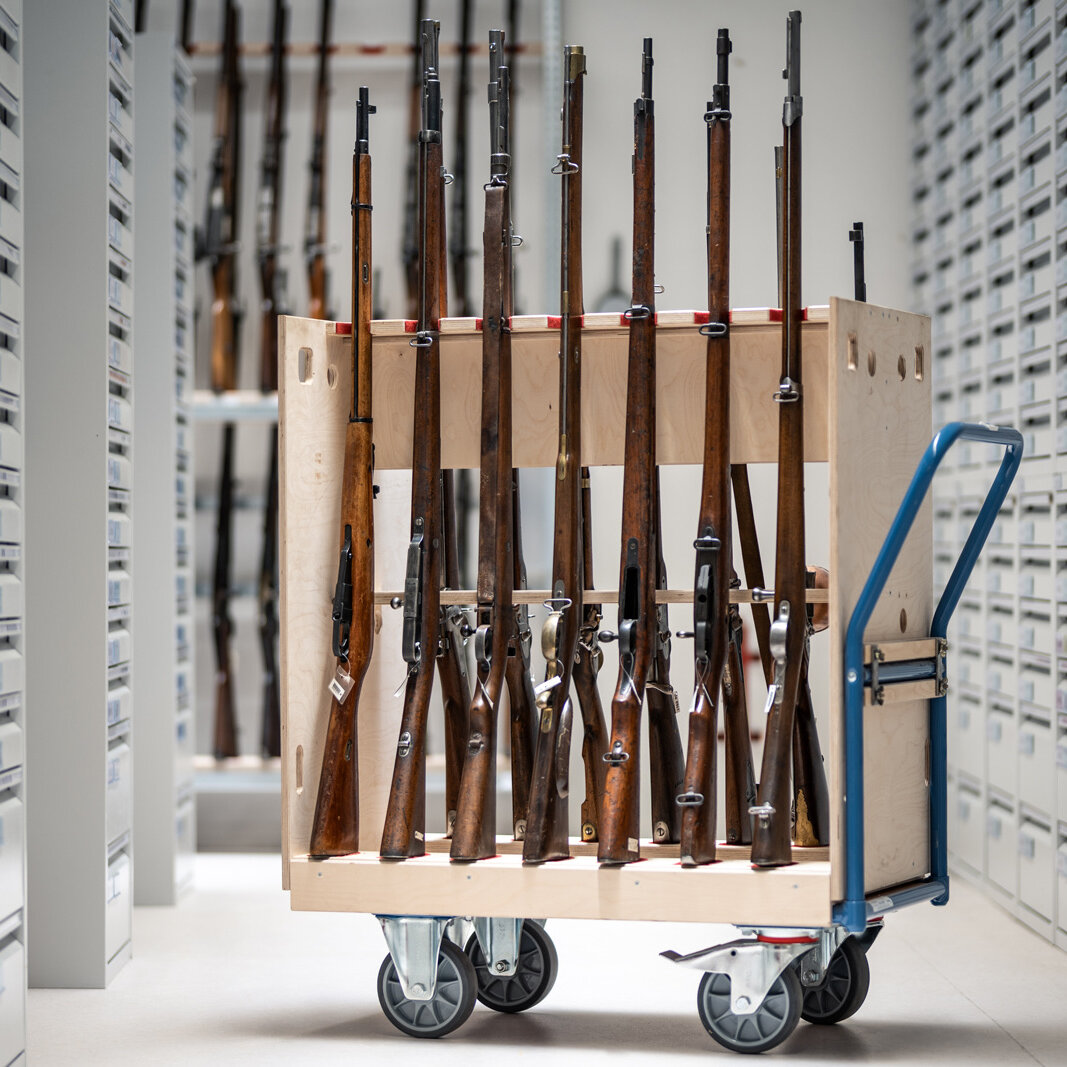
View into a storage area with cabinets and a transport trolley holding historical rifles.
Open copyright info

Collection area

Handheld weapons

Collection area

From medieval lances to modern service weapons

Diversity of a special category of weapons

The term ‘handheld weapons’ encompasses a wide range of weapons used on battlefields throughout history.

Every weapon tells two stories: one about the state of technological development, and one about the violence actually inflicted between people. They illustrate how closely progress and destruction can be intertwined.

The Military History Museum’s collection of handheld weapons comprises more than 17,600 items, ranging from the late Middle Ages to the present day. The different groups of objects are divided into firearms, edged weapons, polearms and accessories. The collection concentrates on weapons developed and used in European culture.

Handheld weapons in the exhibitions

Handheld weapons are a special group of objects. They represent not only the state of the art when they were produced, but also the direct expression of military violence. No other type of weapon makes it clearer that weapons were used by people against people. Although individual weapons can only rarely be attributed to specific individuals, they vividly illustrate how closely technology and violence have been intertwined throughout history.

Firearms

Firearms are weapons that fire projectiles using the combustion of a propellant such as gunpowder. As well as rifles, pistols and revolvers, they include curiosities such as walking-stick shotguns.

The collection is dominated by service weapons – regular weapons that were officially issued to soldiers. The collection is supplemented by a small number of hunting and sporting weapons, such as over-and-under shotguns and small-calibre rifles. Some individual items were once owned by well-known historical figures.

Edged weapons

Edged weapons are defined by the use of blades and are typically used for cutting or thrusting. They may be small and pointed, such as pike bayonets, or significantly larger and heavier, such as sabres.

“The strength of weapons reveals the weakness of man.”

 Rabindranath Tagore

In addition to combat, edged weapons were also used for ceremonial and representative purposes. For this reason, the collection also includes elaborately gilded exhibits featuring genuine Damascus steel blades and fine engravings. Some edged weapons bear information about their owners, or served as mementos for former comrades or one’s period of service.

Polearms – weapons with symbolic power

Polearms consist of a long shaft, usually made of wood or metal, and a blade, spike or mace head at the front end. Typical examples are lances, halberds and war flails. They were usually wielded with both hands. Even today, they can still be found on coats of arms of towns and cities, for example.


About the collection

Click here to learn more about the areas covered by our collection.