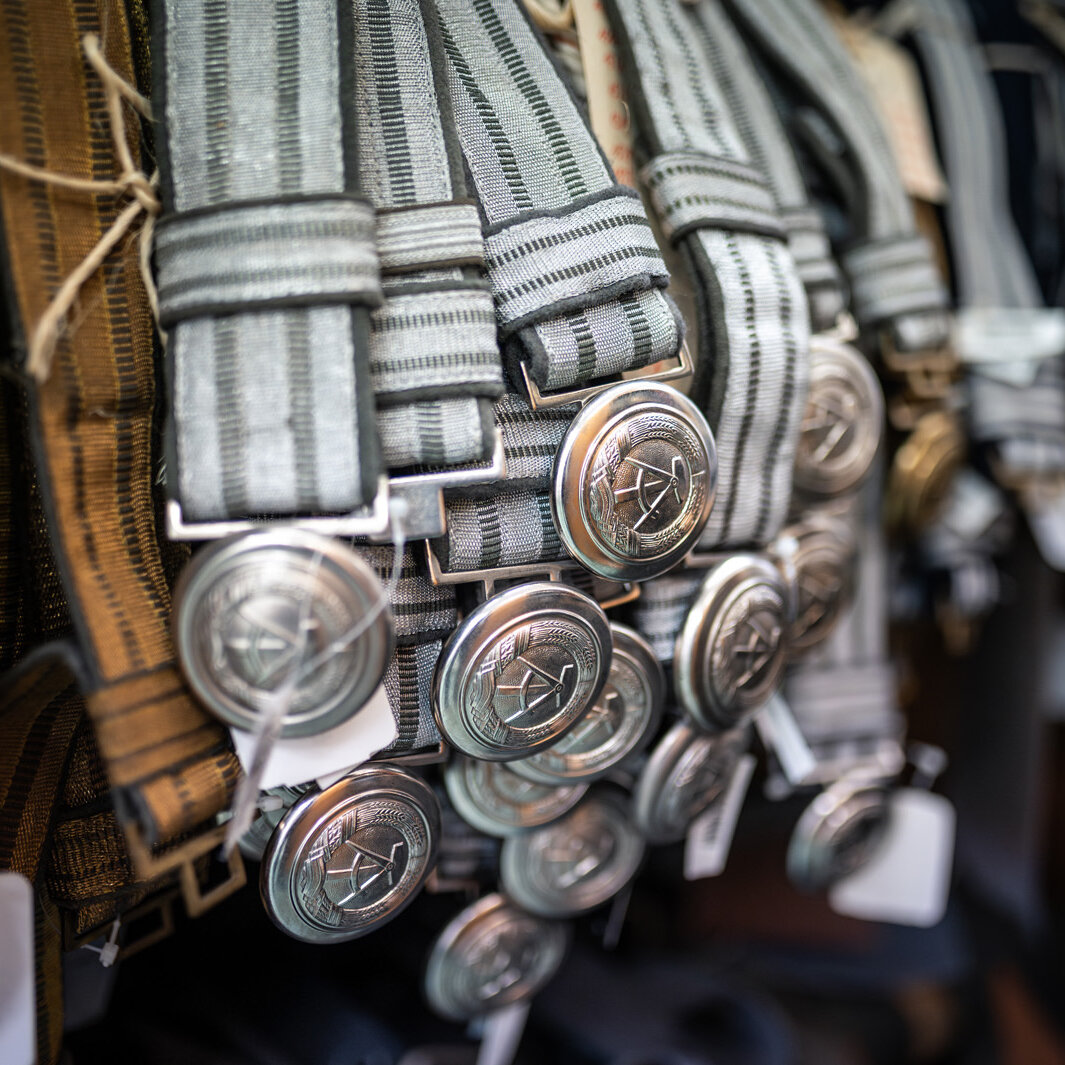
NVA officers’ sashes from the Military History Museum’s collection.
Open copyright info

Collection area

Uniforms and standards

Collection area

Clothing, symbols and music as a reflection of military culture

Symbols of identity and belonging

Uniforms, standards and military music serve to represent armies while also fulfilling important practical functions. They are intended to impress and foster identity, serve as markers for friend and foe, and are indispensable tools in everyday military life. They shape the image of the military both within the armed forces and in the wider public sphere.

This section collects and preserves objects broadly related to military clothing and personal equipment, as well as battle standards, musical instruments and accessories.

With around 85,000 objects, the collection includes an impressive range: from 17th-century infantry armour and 19th-century uniform coats to patches worn by the Bundeswehr on overseas missions.

Uniforms in the exhibitions

Uniforms feature in both the chronological galleries and the themed tours. They serve as signposts through the ages – from the late Middle Ages to the present day – and illustrate the interaction with civilian fashion and the spirit of their time.

Uniforms – equality and difference combined

Military uniforms indicate a soldier’s affiliation with an army, a unit and a rank. However, they are not just symbols of equality, but a nuanced ‘language’ that places people within the military hierarchy. Over time, the demands of war increasingly shifted their representative role towards a practical function as working clothing.

The collection includes headgear, outerwear, footwear, and numerous details such as collar patches and rank insignia. Although the Military History Museum primarily collects uniforms from Bundeswehr, it also has uniforms from foreign armies.

Standards – visible signs of identity

In the strict sense, military standards are flags and banners carried by infantry and mounted troops. They usually consist of a pole, an embroidered or painted cloth, a tip and decorative ribbons. Turkish crescents (jingling johnnies) – percussion instruments with bells used by military bands – also belong to this category.

Military standards carry powerful symbolic meaning. With their emblems visible from afar, they already served as gathering points in antiquity. They provided identification and orientation and embodied the honour of their military unit. Their loss was therefore always considered a deep disgrace.

Armour – protection on the battlefield

[This collection covers military protective armour from the Middle Ages to the present day. It includes classic full iron armour that protected its wearer from head to toe. It also features the cuirasses of 19th-century heavy cavalry, consisting only of breastplates and sometimes backplates as remnants of full armour. There are also forms of armour from the 20th century. 
During the First World War, the need to protect soldiers from projectiles and shrapnel led to the development of steel helmets and sapper armour, and body armour is still used by the military today. Today, however, it is made of lighter materials such as Kevlar.

Kit – soldiers’ load

Soldiers have to carry what they need: not only weapons and ammunition, but also rucksacks, pouches, first-aid kits, mess kits and water bottles. This allows them to remain independent of supply lines to a certain degree.

This gear has always been both a necessity and a burden. It explains why Roman legionaries were nicknamed ‘Marius’s mules’ (muli Mariani). Although soldiers’ missions and equipment has changed due to technological progress, like their ancient predecessors they still have to carry a great deal with them.

Military music – sounds and signals

Since ancient times, music has been an integral part of the military. Signalmen, who were always full-fledged soldiers, used trumpets, drums and whistles to convey commands that could be heard from afar. Their instruments were coveted spoils of war, even though their monetary value was probably not the main consideration.

At the same time, military music was always more than just signalling. Orchestras made up of civilian instrumentalists and their ‘militarized’ successors – military bands – accompanied troops on the march and in battle with their music, and shaped social life at regimental balls and public concerts. Many instruments that were new at the time, such as the valve trumpet and the saxophone, became popular as a result.


About the collection

Click here to learn more about the areas covered by our collection.