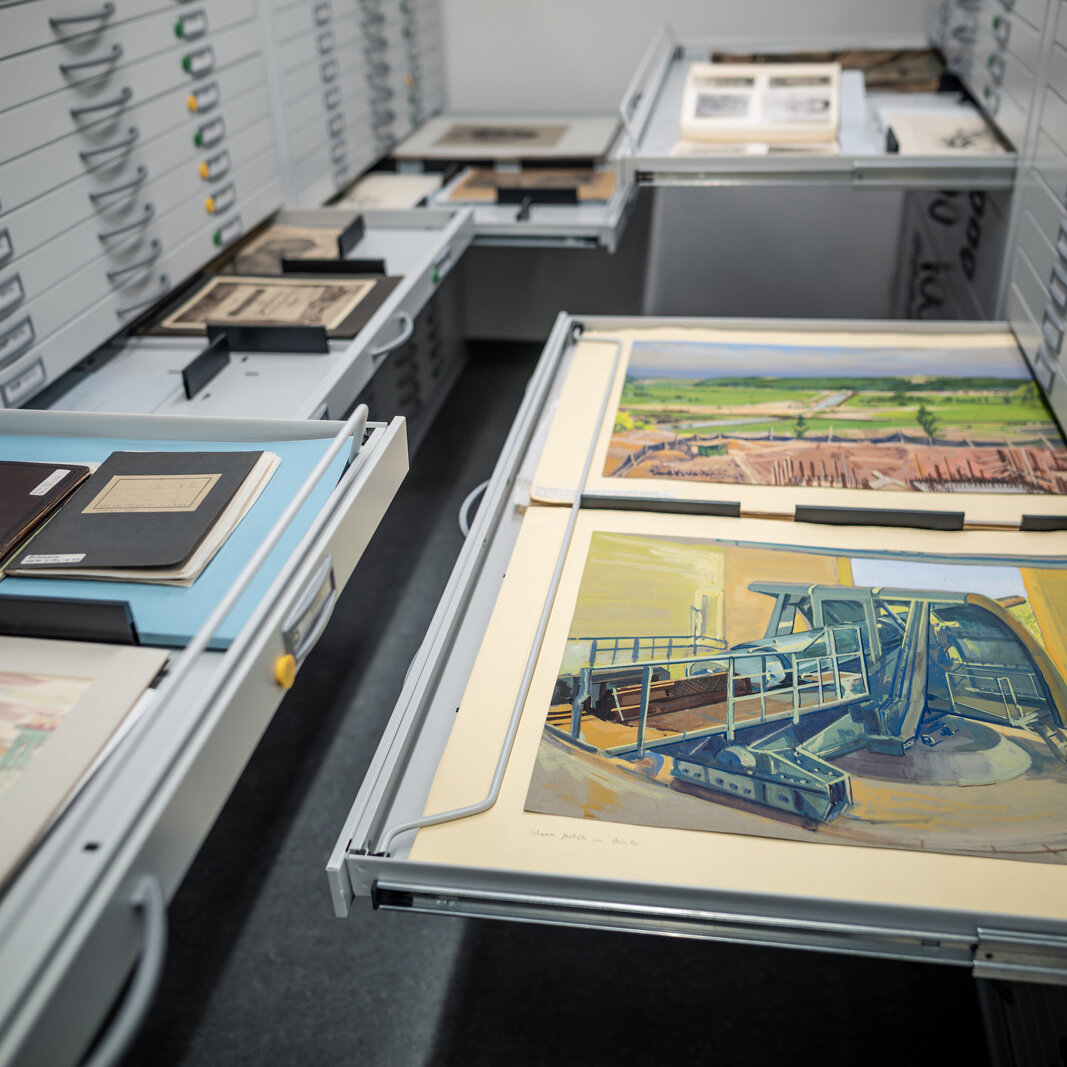
Open drawers in the prints and drawings store, including coloured gouaches from the Second World War by Ernst Vollbehr.
Open copyright info

Collection area

Art

Collection area

Between battle painting, military criticism and contemporary perspectives

Questions posed by art

How do artists view war and peace? What do battle paintings tell us about the period in which they were created? How far can art go in depicting violence? The Military History Museum’s art collection raises questions that still concern us today.

The collection at a glance

The art collection comprises around 45,000 works from the early modern period to the present day, including works by Jacques Callot, Louis Braun, Ernst Ludwig Kirchner, Käthe Kollwitz, Marianne Brandt, Bernhard Heisig, Werner Tübke, Alfred Hrdlicka, Lukas Einsele and Nikita Kadan. The collection includes around 1,500 paintings (including works in glass and textiles), 800 sculptures, 20,000 drawings, watercolours, gouaches, prints and artist photographs, as well as numerous art prints and mass-produced prints. The contemporary art collection continues to grow.

Most of the collection dates from the mid-19th century onwards. Saxon and Prussian traditions of military painting, works relating to the First and Second World Wars, and art from the GDR form the core of the collection. Particularly noteworthy is the extensive collection of art by, for and about the National People’s Army (NVA), which is unique within the German museum landscape.

Foundation of the collection

The origins of the collection date back to 1857, when the young Lieutenant Ludwig Georg Wurmb began collecting illustrations of uniforms and military portraits of the Royal Saxon Army. His ‘army album’ was later acquired by the War Ministry and forms the foundation of today’s art collection at the Military History Museum.

During the era of the GDR Army Museum, the collection was expanded beyond its original Saxon focus, for example through the purchase of Jacob de Gheyn’s (1565–1629) richly illustrated drill manual. Today, the museum collects representative works covering the entire history of the German military and its international context. Portraits from different eras make it possible to examine the transformation of military identities.

Thematic focus

Battle scenes

“It was 9 o'clock in the morning, and we watched through a good telescope for the decisive moment.” With these words, the Prussian battle painter Wilhelm Camphausen described the storming of the Düppel fortifications in the German–Danish War in 1864 – observing the battle from a safe distance. Theodor von Götz, a painter and officer from Dresden who fought in the wars of 1866 and 1870/71, had a very different perspective.

Battle painting flourished in the 19th century. Historical paintings brought battles and events of earlier times to life for the viewer. But contemporary events were also increasingly considered worthy of historical representation. Painters were expected to provide eyewitness perspectives, to conduct thorough research and to be patriotic. Many artists continued to work according to these standards well into the 20th century.

Destruction, injury and death

In many battle paintings, the dead and wounded are only secondary figures. But there were also artists in the past who placed suffering at the centre of their works. During the Thirty Years War, Jacques Callot produced a series of prints depicting the brutal clashes between mercenaries and peasants. Francisco de Goya devoted an entire cycle of etchings to the suffering of the Spanish people in their struggle against Napoleon.

In the 20th century, industrialized mass battles, air raids, the war of annihilation and the Holocaust led to completely new forms of artistic expression. The artistic examination of the consequences of violence forms the core of the collection.

Criticism of the military

Caricatures, collages and adbusting can highlight contradictions and injustices. Some artists reject the military outright, while others play with military symbols or comment ironically on human weaknesses. The collection also includes works that engage more fundamentally with phenomena such as violence, conformity and transgression.

Art and the NVA

The NVA – the National People’s Army of the GDR – commissioned works of art. These were intended to contribute to the ideological education of NVA troops as well as to convey socialist and military values to the population. The Army Museum of the GDR collected works relating to the NVA and its “revolutionary, humanistic and progressive traditions”.

After German reunification in 1990, numerous works from former NVA institutions were added. Today, this collection is supplemented by works that run counter to official positions and broaden the spectrum of artistic expression.

Media history

The collection includes not only works of high artistic merit, but also propaganda art, decorative arts and amateur art. Together with the photographic collection, the art holdings tell a media history of war and violence. What images did people create of violent conflicts at different times? What images did they have in their minds when they themselves had to go to war? Where are the limits of representability? What 19th-century painters understood by ‘realism’ differs greatly, for example, from what we expect today in the age of photography, film and new media.

Photographic...

... collection. If you are interested in military history photographs and films, click here.

Contemporary art

In 2011, the newly conceived Military History Museum, expanded by architect Daniel Libeskind, was opened. Since then, installations and interventions have been an integral part of the museum’s multi-perspective approach. Important works have been acquired for the collection in recent years, such as Nikita Kadan’s ‘Hostomel’ on the war in Ukraine and ‘One Step Beyond’ by Lukas Einsele on landmines and their victims. Jens Umbach’s Afghanistan series focuses on the Bundeswehr. Temporary projects such as the knitted tank by Louisen Kombi Naht (a tailor’s workshop) have attracted considerable attention and prompt reflection on the present and the future.


About the collection

Click here to learn more about the areas covered by our collection.